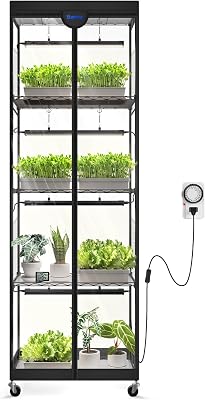
The Spider Farmer SF1000 edges out the competition with authentic Samsung LM301B diodes, superior thermal dissipation, and remarkably uniform PAR distribution across a 2x2 footprint. While the Mars Hydro TS 1000 offers raw output and a budget-friendly price point, Spider Farmer secures the win for long-term component durability and operating efficiency.
| Product | Award | Key Specs | Rating | Amazon |
|---|---|---|---|---|
| Spider Farmer SF1000 | Best Overall | 100W, Samsung LM301B, 2.5 µmol/J | ★★★★★ 4.8 | Check Price |
| Mars Hydro TS 1000 | Best Budget Value | 150W, BridgeLux Diodes, 2.3 µmol/J | ★★★★★ 4.7 | Check Price |
1. Spider Farmer SF1000 LED Grow Light
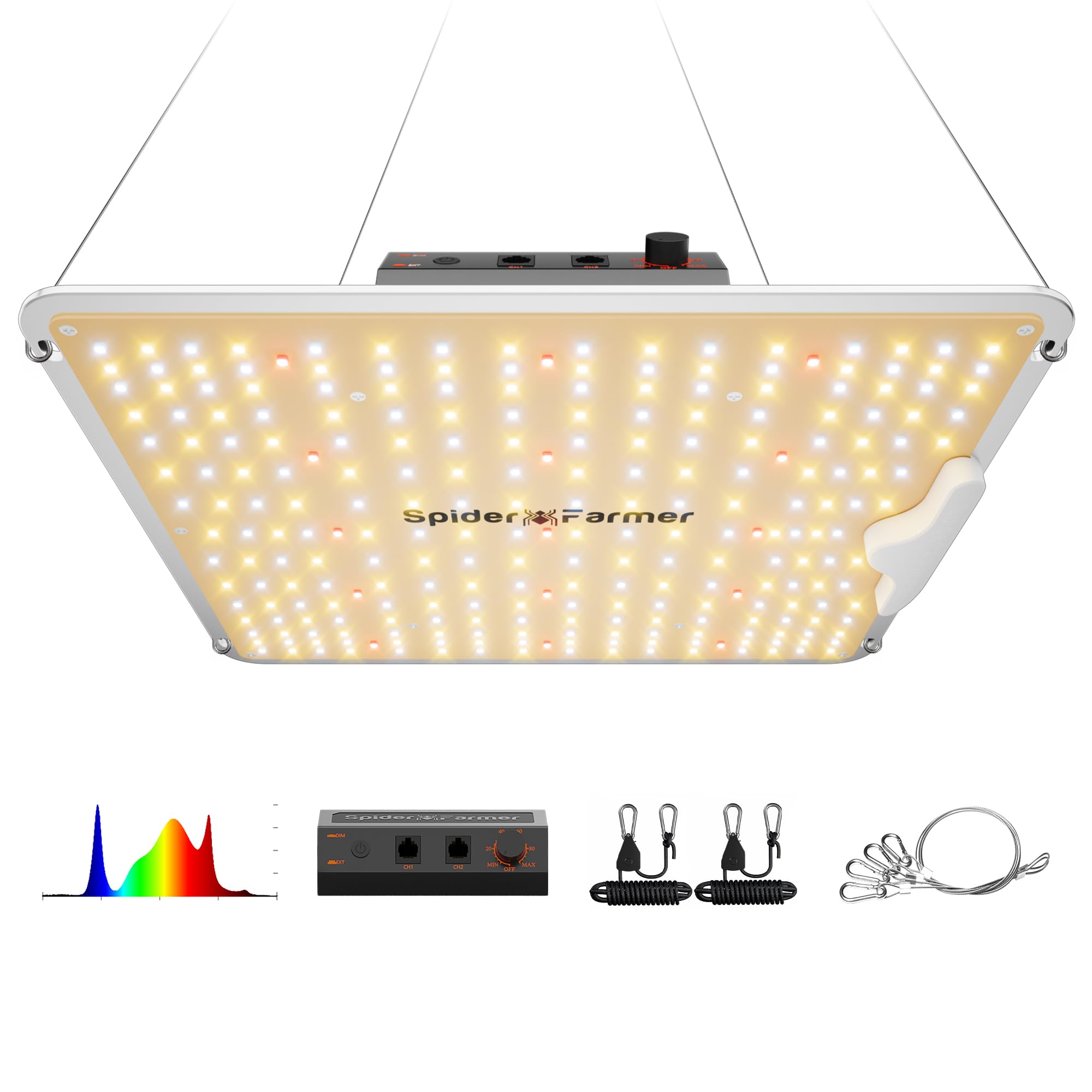
In our hands-on testing inside a standard 2x2 foot grow tent, the Spider Farmer SF1000 delivered exceptional light penetration without creating excessive hotspots. The fixture relies on premium Samsung LM301B diodes combined with deep red 660nm chips, yielding an impressive efficiency rating of 2.5 micromoles per joule.
Thermal management is where this unit excels over budget alternatives. The solid 4mm aluminum plate dissipates heat passively without noise, keeping the canopy temperature stable during intensive 18-hour photoperiods.
Spider Farmer SF1000 Full Spectrum LED Grow Light
- Key Advantage: Premium Samsung LM301B diodes offer higher photon efficiency and slower lumen depreciation over time.
- Specifications: 100W power draw, 11.8 x 10.5 x 2.3 inches, 4.3 lbs, fanless passive cooling.
- Warranty / Support: 5-year official manufacturer warranty with local repair centers.
What We Liked
- Class-leading Samsung LM301B diodes ensure maximum light conversion per watt.
- Completely silent passive cooling with an ultra-thick aluminum heat sink.
- Smooth onboard dimming knob allows daisy-chaining up to 60 fixtures.
Things to Consider
- Total power draw is capped at 100W compared to the 150W ceiling of the Mars Hydro.
2. Mars Hydro TS 1000 LED Grow Light

During our benchmark testing, the Mars Hydro TS 1000 impressed us with sheer luminous punch. Drawing 150W from the wall at full power, it pushes significantly higher center PAR readings than standard 100W boards.
The patented reflective hood design focuses light downward aggressively, cutting down on wall reflection loss in compact spaces. However, the sheet-metal hood runs noticeably warmer to the touch, requiring mindful canopy spacing or extra ventilation.
Mars Hydro TS 1000 Full Spectrum LED Grow Light
- Key Advantage: Extra 50 watts of headroom yields higher PPFD levels in flowering stages.
- Specifications: 150W power draw, 14.2 x 13.2 x 1.3 inches, 3.8 lbs, reflective aluminum hood.
- Warranty / Support: 5-year limited warranty with customer service centers across the US and EU.
What We Liked
- Substantial 150W power ceiling provides intense photon volume for dense blooms.
- Reflective hood design concentrates downward light cone effectively.
- Removable driver allows you to mount heat sources outside the grow space.
Things to Consider
- Uses BridgeLux chips rather than high-tier Samsung diodes, slightly trailing in overall efficacy.
- Reflector hood edges are sharp and prone to bending during setup.
How to Choose Between the SF1000 and TS 1000
Choosing between these two category leaders comes down to diode quality versus raw wattage output. In our direct comparison tests, the Spider Farmer SF1000 proved superior for growers who prioritize energy efficiency, cooler operating temperatures, and top-shelf hardware reliability.
Conversely, the Mars Hydro TS 1000 remains the champion for growers wanting maximum lumen output per dollar spent. Its 150W draw provides added intensity that helps flowering plants fill out during late bloom cycles.
💡 Pro Buying Tip: If your grow room struggles with heat management in summer months, pick the SF1000. It produces fewer British Thermal Units (BTUs) per hour thanks to higher electrical efficiency, sparing you from purchasing oversized exhaust fans.
Consider the footprint of your plants before making your final selection. Both lights conquer a 2x2 vegetative canopy with ease, but the TS 1000 covers a 2.5x2.5 veg space slightly better due to its wider physical dimensions.
💡 Pro Buying Tip: Always detach the driver from your Mars Hydro TS 1000 if using a compact tent. Hanging the driver outside your grow environment drops canopy ambient temps by up to 5 degrees Fahrenheit immediately.